




Your Ultimate Venice Travel Guide for Solo Explorers
My ultimate Venice travel guide for solo explorers. Discover practical tips, safety advice, and a 3-…

A marvel of human ingenuity and artistic splendor, Venice seamlessly blends history and charm. From the grandeur of St. Mark’s Basilica to the hidden beauty of its quiet backstreets, the city is a living museum where every corner reveals a new story. With its unique beauty and timeless appeal, Venice is truly a destination like no other.
Venice is unusual among European cities in that it is simultaneously one of the most over-visited and one of the most genuinely worth visiting. The contradiction resolves when you understand when and where to be. A morning walk through Cannaregio before the day-trip crowds arrive from the cruise ships, an evening in a bacaro drinking spritz with locals, a vaporetto ride to Murano or Burano when everyone else is queuing for gondolas; these experiences are available to anyone who visits with a degree of intention and timing, and they are especially available to solo travellers who can move independently of group schedules.
Venice is also, despite its romantic reputation, a city that works very naturally for solo travel. It is compact and walkable in a way no other major European city quite matches. It has no cars, which makes navigation less stressful. And its character, quiet, layered, somewhat melancholy out of peak tourist season, is one that solo travellers tend to appreciate more than groups. Getting lost is not a problem in Venice; it is the point.
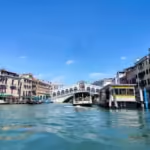
Genuinely yes, with two important caveats. First, day-tripper Venice and stay-overnight Venice are different cities. The day-trip version, arriving mid-morning, seeing the Piazza San Marco and the Rialto Bridge, eating at a tourist restaurant, leaving by evening, is crowded, expensive, and a fraction of what the city is. The overnight version, where you’re moving around at 7am and 9pm when the crowds have gone, is something else entirely.
Second, Venice is expensive and getting more so. The city has a day-tripper entry fee (€5, introduced in 2024) which does not apply to overnight guests. Accommodation is pricier than elsewhere in Italy. But budget options exist, particularly in Cannaregio and Castello, and the free pleasures of the city, walking its 118 islands, the vaporetto, the bacaro culture, are genuine and accessible.
ACTIVITIES
There are quite a few activities you can do in and around the city. Venice is filled with historical and cultural landmarks.
ATTRACTIONS
There are quite a few attraction you can visit in and around the city. Venice is filled with historical and cultural landmarks.
FOOD AND DRINKS
Classic Venetian, Italian, and international cuisine, they are all on the menu.
ACCOMMODATION
Hotels for every taste and luxury levels, guest houses and various accomodation options available.
Cannaregio is the best neighbourhood for solo travellers staying overnight. It is the most residential of the central sestieri, has the best concentration of local restaurants and bars away from the tourist circuit, and connects easily to the Santa Lucia train station at one end and the Rialto at the other. Accommodation is slightly cheaper here than in San Marco and the area has a noticeably more local character.
Castello, east of San Marco, is larger and less touristic than the centre, with some excellent local restaurants and a quieter character. It is slightly less convenient for the main sights but a good choice for a longer stay.
Avoid staying in San Marco if you want any sense of authentic Venice, it is the most crowded, most expensive, and least residential of the sestieri. Beautiful to walk through; less pleasant to sleep in.
The Lido, Giudecca and other outer islands are options for those who want something genuinely different and don’t mind a vaporetto commute into the centre. Giudecca in particular is interesting as a quieter residential alternative.
Venice is one of the safest cities in Europe for solo travellers. The absence of cars removes one of the common urban hazards. Violent crime is essentially absent from the tourist experience. The main practical concerns are: getting genuinely lost (mostly fine, the islands are not large and the lagoon is a boundary), missing the last vaporetto (check return times if going to outlying islands), and the tourist-area overcharging that is endemic around San Marco.
Solo female travellers will find Venice exceptionally comfortable, it is a city where walking alone at any hour feels genuinely safe, the low-level street harassment common in some southern Italian cities is largely absent, and the social environment in the bacari is friendly and unregimented.

Venice has no roads. You walk, or you take the vaporetto (water bus). The vaporetto network covers all the main islands and the Grand Canal. A 48-hour or 72-hour travel card is good value if you’re moving around frequently. Line 1 runs the length of the Grand Canal and is worth taking at least once for the views, though it is slow. Line 2 is faster for getting from Santa Lucia station to San Marco.
Walking is the primary mode of transport within the islands. Navigation apps work in Venice (Google Maps and Maps.me both handle it well) but it is worth allowing extra time when navigating on foot; distances are longer than they look on a map because of bridges and dead ends at the water. Getting mildly lost is essentially unavoidable and is part of the experience.
The bacaro is Venice’s answer to the bar, small, often standing-only, serving cicchetti (small plates, similar to tapas) and wine by the glass (ombra). This format is inherently and perfectly solo-friendly. The best bacari are in Cannaregio and the Rialto Market area (around Campo de la Beccarie). You order what looks good from the counter, pay per piece, drink a spritz or a glass of local white wine, and move on. It is one of the most relaxed and enjoyable solo dining formats in Europe.
For sit-down meals, look for restaurants with a fixed-price lunch menu (tourist menu or menu del giorno) in Cannaregio or Castello and avoid the restaurants immediately surrounding San Marco and the Rialto Bridge, which are almost uniformly overpriced and poor quality. The local rule, if the menu is in multiple languages and there is a host outside trying to attract custom, walk away, applies with particular force in Venice.
Best time to visit: November to February (excluding Christmas and Carnival) is the ideal time for solo travel in Venice. The crowds are a fraction of summer, the prices drop significantly, the city takes on its characteristic winter atmosphere of mist on the lagoon and empty calli, and you can walk through San Marco in the morning with almost no one else there. Carnival (February) is spectacular but intensely crowded and expensive.
Avoid summer (June to August) if you can, the combination of heat, crowds and the day-tripper influx from cruise ships makes the city significantly less pleasant. Spring (April-May) is popular but manageable.
Day trips: Murano (glass) is 10 minutes by vaporetto and worth a morning. Burano (coloured houses, lace) is 45 minutes and genuinely picturesque. Torcello (the oldest island, near-abandoned) is for those who want to understand Venice’s origins. All are included in the vaporetto travel card.
The tourist entry fee (€5) applies to day visitors on peak dates only, overnight guests are exempt. Check the current list of applicable dates at veneziaunica.it.
Written by Lily Evans, solo travel writer at gotravelyourself.com. Lily specialises in European slow travel and has travelled solo across Italy and the continent for 9 years.