


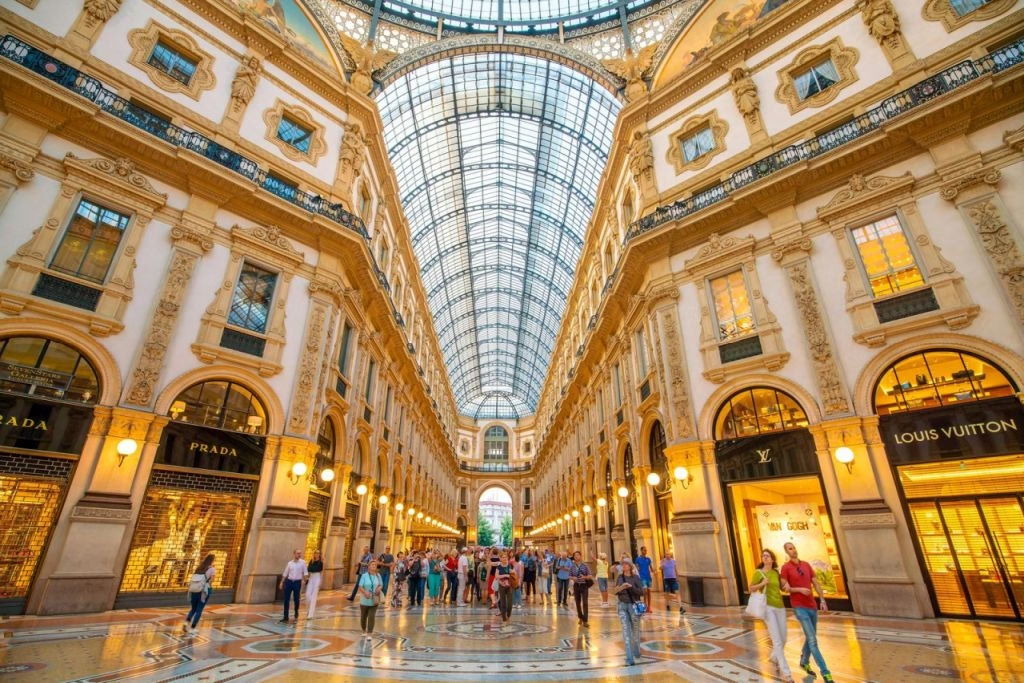


Amsterdam on a budget: how to survive the most expensive city in Europe
Amsterdam on a Budget explains how to manage expenses and enjoy the most expensive city in Europe th…

Europe has long captivated travelers with its diverse blend of history, culture, landscapes, and modern sophistication. Spanning 44 countries and boasting countless languages, traditions, and cuisines, Europe offers an unparalleled variety of experiences for every type of traveler. Whether you’re an adventurer seeking Alpine peaks, a history buff eager to explore ancient ruins, or a foodie craving authentic pasta in Italy or freshly baked baguettes in France, Europe promises a journey filled with discovery and wonder.
Europe is the most accessible major solo travel region in the world. The infrastructure is reliable, the distances are manageable, the train network connects almost everywhere worth going, and the cultural variety within a short travel radius has no equivalent on any other continent. A solo traveller can move from the coffee houses of Vienna to the splav clubs of Belgrade to the Gothic Quarter of Barcelona within a week without a single long-haul flight. That combination of density, variety and practical ease is what makes Europe the natural starting point for most people’s first solo trip — and the reason experienced solo travellers keep returning.
The solo travel case for Europe is particularly strong because of how it handles being alone in public. The café cultures of Paris, Vienna and Lisbon, the pub culture of London and Dublin, the bar-hopping street culture of Barcelona and Belgrade — these are social environments designed around individual presence. You are not conspicuous alone in a European city. You are normal.
The honest answer is that most major European cities are good for solo travel, but they are good in different ways. The city you choose should match what you are looking for from solo travel rather than from a generic ‘top 10’ list.
For first-time solo travellers: London, Prague and Lisbon are the most forgiving combination of English-language accessibility, clear tourist infrastructure and genuinely interesting cities. They allow you to concentrate on the experience of being solo without also navigating an unfamiliar language or complex transport system.
For experienced solo travellers who want more depth: Vienna, Berlin, Barcelona and Belgrade reward visitors who can navigate independently and want a city that reveals itself over days rather than at first glance. These are cities where speaking a little of the local language, knowing which neighbourhoods to stay in, and arriving without a fixed itinerary produces a qualitatively different experience.
For solo female travellers specifically: the northern and central European cities (Vienna, Prague, Berlin, Amsterdam, Copenhagen, Lisbon) consistently score highest for safety and comfort. Southern European cities require more situational awareness, particularly at night, but are not unsafe — the calibration is different, not the verdict.
The Interrail and Eurail pass systems make train travel across Europe practical and often economical for solo travellers covering multiple countries. Point-to-point tickets on high-speed trains (Eurostar, Thalys, the French TGV network, the Austrian Railjet, Deutsche Bahn ICE) are faster and sometimes cheaper when booked in advance. The key rule: book fast trains at least 3–6 weeks ahead. Walk-up prices for high-speed services are significantly higher than advance fares.
Budget airlines (Ryanair, easyJet, Wizz Air) cover routes that trains do not — particularly to Eastern European cities (Warsaw, Bucharest, Sofia) and to island destinations. They are cheap when booked early and unpredictable when booked late. For solo travellers, the flexibility of not checking luggage (hand luggage only) reduces both cost and stress significantly.
Europe is safe by any global standard. The practical risks for solo travellers are almost universally petty theft in tourist-heavy areas: pickpocketing around popular sights in Barcelona, Rome and Prague; bag snatching on motorbikes in certain parts of Southern Europe; scam ecosystems around major train stations. These are specific, avoidable risks rather than generalised danger.
The safety landscape varies by sub-region. Western and Northern Europe have low crime rates and predictable environments. Central Europe (Czech Republic, Austria, Hungary, Poland) is very safe. The Balkans (Serbia, North Macedonia, Albania, Bosnia) are significantly safer than their reputations suggest and getting safer as tourism develops. Eastern Europe (Ukraine excluded for obvious reasons) is generally comfortable for independent travellers with normal awareness.
May, June, September and October are the most consistently good months for solo travel across Europe — warm enough in the south, not oppressively hot, crowds manageable, prices below July/August peak. July and August are the most expensive months with the highest tourist volumes across all major destinations. Winter (November to March) is cheaper, less crowded, and genuinely atmospheric in many cities (Christmas markets, Vienna winter, Prague in snow) — but some outdoor activities and smaller attractions close seasonally.
Browse the city guides below for specific destinations or use the country pages to start planning your European solo itinerary.
Written by Jennifer Ann Porter, solo travel writer at gotravelyourself.com. Jenny has travelled solo across Europe for 9 years covering 60+ destinations.