


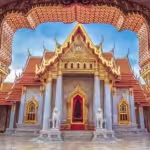


Solo Travel in Bangkok: Temples, Street Food & Where to Stay Guide
Solo travel in Bangkok involves exploring historic temples, savoring diverse street food, and choosi…

Bangkok, the bustling capital of Thailand, is a city that dazzles visitors with its unique blend of tradition and modernity. Known locally as Krung Thep Maha Nakhon, or simply “Krung Thep” (City of Angels), Bangkok is a dynamic metropolis that offers something for everyone. From centuries-old temples and vibrant markets to luxurious shopping malls and buzzing nightlife, Bangkok is a city of contrasts and endless discoveries.
Bangkok is one of the great first solo travel cities and one of the great recurring solo travel cities simultaneously. First-timers find it accessible, stimulating, and manageable in a way that larger reputations sometimes obscure: the street food alone justifies the trip, the transport is getting better, and the sheer sensory density makes solo walking an activity in its own right. Return solo travellers find it endlessly rewarding precisely because it doesn’t reveal itself quickly, the more time you spend in specific neighbourhoods, the more the city opens up.
The common anxieties about Bangkok solo travel: scams, heat, language barrier, navigating the city, are all real and all manageable. Bangkok’s solo travel infrastructure is mature. The city has had international independent visitors in large numbers for decades, and the accommodation, food and transport options for budget and mid-range solo travellers are among the best in Asia.
ACTIVITIES
There are quite a few activities you can do in and around the city. Bangkok is filled with activities for all tastes and ages.
ATTRACTIONS
There are quite a few attraction you can visit in and around the city. Bangkok is filled with historical and cultural landmarks.
FOOD AND DRINKS
Classic Thai food and wide variety of international cuisine are making Bangkok a foodie paradise, fit for everyone’s taste.
ACCOMMODATION
Hotels for every taste, guest houses and various accomodation options available.
Exceptionally, with the caveat that the city rewards some prior research more than most. Knowing which neighbourhoods suit your interests, which transport options to use in which circumstances, and the basic scam patterns before you arrive makes the difference between a trip that flows and one that involves constant recalibration.
The language situation is better than people expect. Thai script is not immediately legible to most Western visitors, but English is reliably spoken in tourist areas, on food stalls and in most accommodation. Google Translate’s camera function is useful for menus and street signs.
Silom and Sathorn (central Bangkok, south of the Chao Phraya) are the best bases for solo travellers who want reliability and connectivity. The BTS Skytrain covers the area, the accommodation range is excellent, and both Silom (mixed residential, gay-friendly, Patpong night market) and Sathorn (more upscale, quieter) have good restaurant options at every price point.
Ari and Phrom Phong (further north on the BTS Sukhumvit line) are the residential Bangkok that expats and longer-term visitors choose: good coffee shops, the Emporium and EmQuartier malls for air-conditioned food halls, and a quieter atmosphere than the tourist circuit. Excellent for a second Bangkok visit.
Khao San Road area (Banglamphu) is the classic backpacker district and entirely functional as a base for a first Bangkok visit, cheap accommodation, easy connections to temples, and a social scene that makes meeting other solo travellers very easy. It is also the most tourist-concentrated area of the city and loses its interest quickly for repeat visitors.
Avoid staying in Sukhumvit Soi 11 area for solo female travellers specifically, the concentration of nightlife venues creates an environment that requires more navigation than other parts of the city.
Bangkok is generally safe for solo travellers. The risks are specific rather than general: tuk-tuk gem scams (you’re taken to a ‘government gem sale’, always decline), temple closure scams (a friendly stranger tells you your planned temple is closed and offers to take you somewhere else, it isn’t closed, this is a diversion), and overcharging taxi drivers who don’t use meters.
Practical countermeasures: always insist on the meter in metered taxis, use Grab (the regional Uber equivalent) for fixed-price rides, decline all unsolicited guide offers near temples, and never enter a tuk-tuk from a tout at a major tourist site.
Solo female travellers: Bangkok is broadly comfortable with the standard urban awareness. The Buddhist culture and the tourist infrastructure mean harassment directed at foreign women is less common than in some other Asian cities. Be aware of the concentration of specific male-oriented venues in certain areas (Nana, Patpong, Soi Cowboy), these are easy to navigate around.
Bangkok traffic is severe and the city’s transport options matter enormously to your experience. The BTS Skytrain (above-ground, covering the Sukhumvit and Silom lines) and MRT (underground, covering additional central areas and the airport link) are fast, air-conditioned, and cheap. Use them whenever possible and plan your accommodation around BTS or MRT access.
The Chao Phraya river boat is an excellent and cheap way to travel along the river, useful for reaching the major temples (Wat Pho, Wat Arun, the Grand Palace) from the Silom/Sathorn area. For short hops in traffic, motorbike taxis (orange vests, available at most intersections) are faster than any four-wheeled option.
Suvarnabhumi Airport to the city: the Airport Rail Link to Phaya Thai BTS station takes 30 minutes and costs a fraction of a taxi. Take it.at Road (Bangkok’s Chinatown) or Khao San Road, where food carts line the streets, offering dishes that cater to every palate..
Bangkok may be the best city in the world for solo dining. The street food culture specifically accommodates single diners, you point, you pay, you eat, you move on. No table required, no minimum spend, no social pressure. The plastic stool tables at street food vendors throughout Silom, Yaowarat (Chinatown) and Or Tor Kor Market are among the most pleasurable solo dining experiences anywhere.
The Or Tor Kor Market (near Mo Chit BTS) is where Bangkokians with high food standards buy prepared food and fresh ingredients — the ready-to-eat section has superb quality at market prices. The night market at Jodd Fairs (Rama IX area) is one of the city’s best evening markets. Yaowarat (Chinatown) on any evening is a solo dining experience of exceptional quality.
Best time to visit: November to February, the cool, dry season. March-May is very hot. June-October is the rainy season, manageable but with heavy afternoon downpours most days.
Heat management: Bangkok in summer regularly exceeds 35°C with high humidity. Walk in the morning, use air-conditioned transport and spaces from noon to 4pm, and schedule outdoor temple visits for early morning (before 9am) or late afternoon (after 4pm).
Temple dress codes: shoulders and knees must be covered at all major temples. Carry a lightweight scarf or long trousers. The Grand Palace and Wat Pho both have sarong hire if you arrive underdressed.
SIM cards: buy a Thai SIM at the airport on arrival (AIS, DTAC or True Move H). Data is cheap and fast, and having data makes navigation and Grab access significantly easier.
Written by Vamika Sharma, solo travel writer at gotravelyourself.com. Vamika specialises in Southeast Asia and India and has travelled solo across Thailand over 8 years.