


How many days do you need for Milan?
If you’re planning a trip to Milan, you might be wondering how many days you need to explore everyth…
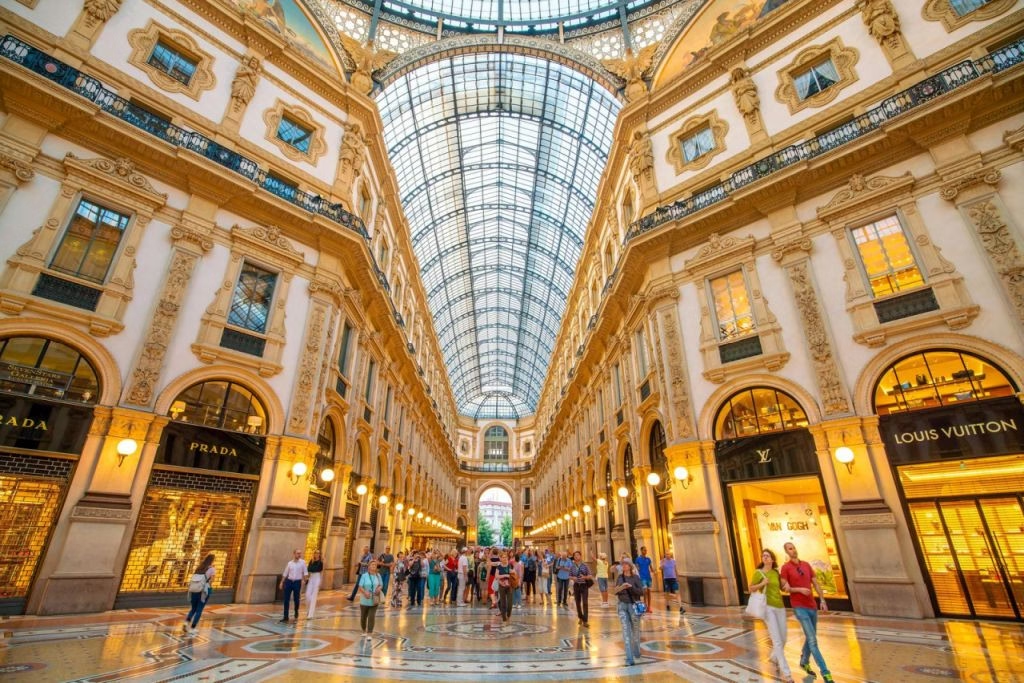
Milan is a city of contrasts—a place where ancient cathedrals stand alongside modern skyscrapers, where Renaissance art coexists with cutting-edge design, and where traditional flavors meet global influences. A visit to this vibrant city is more than a trip—it’s a journey into the heart of Italian style, creativity, and innovation.
Milan is the Italian city that surprises people the most. Its reputation is for business, fashion and expense — none of which are obviously solo-travel-friendly — but in practice it functions well for independent visitors. The metro system is efficient, the aperitivo culture is one of the best in Italy for solo drinking and socialising, and the city has enough to fill several days comfortably without the extreme tourist pressure of Rome, Florence or Venice.
The city also benefits from being underestimated. Visitors who come expecting a purely commercial city find the Navigli canal district, the Brera art neighbourhood, the Pinacoteca di Brera (one of Italy’s finest art collections, never crowded), and a food scene that has significantly outgrown its stereotype of over-priced and style-over-substance.
There are quite a few activities you can do in and around the city. Milan is filled with exciting activities.
Read MoreThere are quite a few attraction you can visit in and around the city. Milan is filled with historical and cultural landmarks.
Read MoreMilan is a foodie paradise, besides traditional Italian dishes, there are plenty of local ones, such as Costoletta alla Milanese.
Read MoreThere are quite a few options for lodging in the city: guest houses, apartments, budget and luxury hotels.
Read MoreYes, particularly for solo travellers who like cities to reward them rather than just impress them. Milan requires a bit more lateral thinking than a more obviously ‘beautiful’ Italian city — it doesn’t hand you its best at the first intersection — but that suits independent travel. The neighbourhoods worth knowing take an hour of walking to find and are considerably better than the tourist circuit around the Duomo.
The aperitivo culture is genuinely ideal for solo travellers: arrive at a bar between 6 and 9pm, pay €8-12 for a drink, and access a buffet of food that functions as dinner. In the Navigli and Brera neighbourhoods, these are not tourist operations — they are how Milanese professionals eat on weeknights. Standing at a bar counter alone, eating from a shared buffet, is entirely natural here.
Brera is the best base for a solo trip. It is the historic art district — the Pinacoteca di Brera is here, as are excellent restaurants, wine bars, and a walkable, human-scale street layout. It is also more affordable than staying directly adjacent to the Duomo.
Navigli (the canal district, south of the centre) is the best area for evening aperitivo and nightlife. The two main canals (Naviglio Grande and Naviglio Pavese) are lined with bars and restaurants, and the atmosphere is genuinely local rather than tourist-oriented. Worth the metro ride from the centre.
Porta Romana and Porta Venezia are quieter residential neighbourhoods with good restaurants and lower accommodation prices — worth considering for longer stays.
Milan is a safe city for solo travellers. The usual urban caveats apply around the main train stations (Centrale and Garibaldi), which have higher concentrations of opportunistic crime. The metro is safe during normal hours. The city centre and tourist neighbourhoods are comfortable at night.
Milan’s metro is excellent — four lines covering the city comprehensively. The day pass or a book of tickets is the most efficient way to travel. The historic centre is walkable but distances between neighbourhoods are longer than Florence or Venice, and the metro is frequently the better option for cross-city journeys.
The main international airport is Malpensa (MXP), about 50km from the city. The Malpensa Express train connects to Cadorna and Garibaldi stations in 40-50 minutes and is by far the best option. Linate (LIN) is closer and serves European routes; the metro connection (Line 4) opened in 2023. is one of the world’s most prestigious opera houses. Attending a performance here is a once-in-a-lifetime experience for music lovers.
The aperitivo format is the definitive solo dining experience in Milan. Beyond that, the city has excellent counter-service restaurants in the Brera and Porta Romana areas. The traditional Milanese dishes — risotto alla Milanese, cotoletta (breaded veal cutlet), ossobuco — are best in the traditional trattorie in Brera and the Porta Romana neighbourhood. The Peck delicatessen near the Duomo is one of Italy’s great food shops and excellent for self-assembled lunches.
Best time to visit: March-April and September-October avoid the heat and the Fashion Week crowds (September and February/March are fashion weeks — the city is very busy and hotels are expensive during these periods).
The Last Supper: Leonardo da Vinci’s Last Supper (Santa Maria delle Grazie) requires advance booking months ahead — it is one of the most restricted art viewings in the world, with only 25 visitors admitted per 15-minute slot. Book via vivaticket.com at least two months ahead. Worth it.
Day trips: Lake Como (1 hour by train from Centrale), Bergamo (50 minutes), Brescia (50 minutes). Milan’s train connections make it one of the best day-trip bases in Northern Italy.
Written by Lily Evans, solo travel writer at gotravelyourself.com. Lily specialises in European slow travel and has travelled solo across Italy for 9 years.