


How safe is New York City for tourists?
New York City is one of the most visited cities in the world. Every year, millions of people flock t…

New York City is a global hub of culture, entertainment, history, and excitement. Whether you’re walking through its historic streets, experiencing its nightlife, indulging in world-class dining, or simply soaking in the city’s energy, there’s something for everyone in NYC.
From the bright lights of Times Square to the peaceful paths of Central Park, from the top of the Empire State Building to the underground art scene of Brooklyn, New York City is an unforgettable travel destination that should be on everyone’s bucket list.
New York is one of those cities where solo travel removes one of the main obstacles people encounter: the negotiation. A group visiting New York will spend half its time debating which neighbourhood to prioritise, which museum to visit, whether to do the Empire State Building. A solo visitor just goes. The city is designed for this, it is walkable at human scale (each block has something on it), its public spaces are busy enough that being alone never feels exposed, and the New York pace of life makes solitary movement the default state rather than an exception.
The practical challenges are real: New York is expensive, large and initially overwhelming. But the subway, once understood, is one of the world’s great transport systems, and the density of the city means that even modest navigation opens up enormous variety.
There are quite a few activities you can do in and around the city. New York City is filled with exciting activities.
Read MoreThere are quite a few attraction you can visit in and around the city. New York City is filled with famous landmarks.
Read MoreNew York City is a foodie paradise, besides traditional American and world dishes, there are plenty of local ones, such as Manhattan clam chowder.
Read MoreThere are quite a few options for lodging in the city: guest houses, apartments, budget and luxury hotels.
Read MoreExcellent, with budget management as the primary challenge. New York is expensive at every level: accommodation, food, transport, activities. The mitigation: the city has more free culture than almost any other (free admission at the Metropolitan Museum of Art on a ‘pay what you wish’ basis, the High Line, Central Park, the Brooklyn Bridge walk, the Staten Island Ferry past the Statue of Liberty) and the food price range is enormous, from world-class for under $15 to world-class for $200. Understanding how to eat well cheaply, the delis, the ethnic restaurants in Flushing and Jackson Heights, the food halls, changes the budget significantly.
Brooklyn, specifically Williamsburg, Brooklyn Heights, and Park Slope, has become the right answer for many solo visitors who want the New York experience without staying in a Manhattan hotel at Manhattan prices. Williamsburg in particular: excellent food, accessible via the L train to Manhattan in 15 minutes, good accommodation options, and a neighbourhood character that is genuinely distinct from tourist Manhattan.
For Manhattan, the Upper West Side (between Central Park and the Hudson, 70s-80s streets) is pleasant, residential, and significantly cheaper than Midtown. It is within walking distance of the Museum of Natural History, the Met, and Central Park, and has excellent neighbourhood restaurants and cafes.
Avoid basing yourself in Midtown (Times Square area), it is the most expensive part of the city, the most tourist-heavy, and the least representative of actual New York life. Worth passing through; worth not sleeping near.
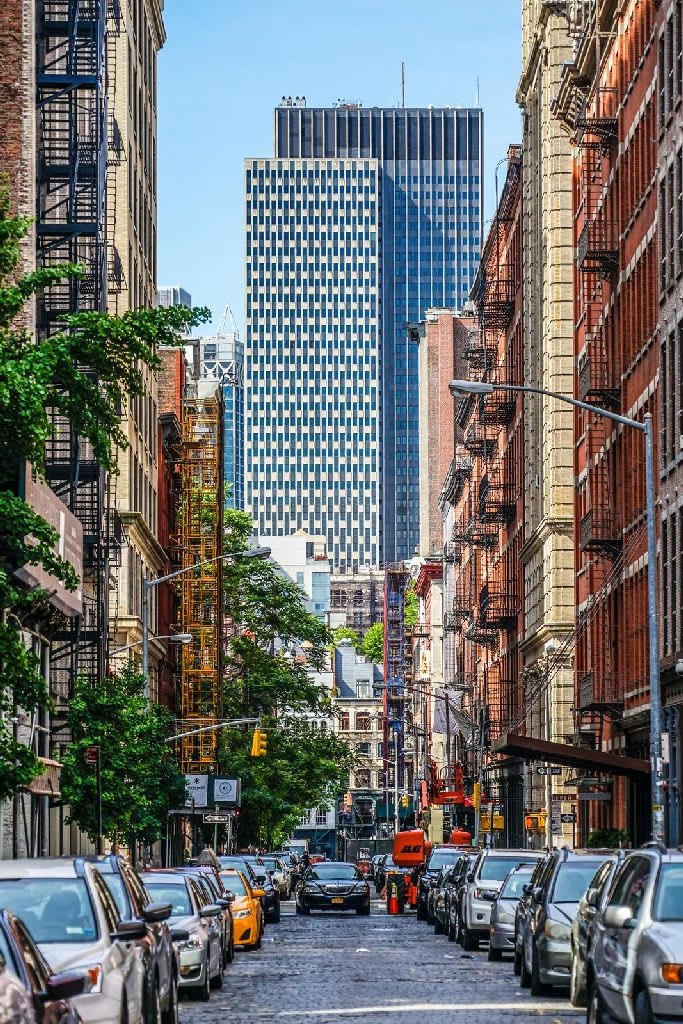
New York’s safety has improved enormously over the past thirty years and is substantially better than its reputation for many visitors. The tourist areas of Manhattan (Midtown, the Village, SoHo, Lower Manhattan) are very safe. The subway is generally safe during normal hours, with the standard urban awareness around late-night travel on less-busy lines.
Areas requiring more awareness: parts of the Bronx and East New York (Brooklyn) that are off the tourist circuit, these are not places visitors typically end up accidentally. The tourist areas are safe.
Solo female travellers: New York’s size and anonymity can feel both liberating and slightly overwhelming. The city’s culture of everyone minding their own business is protective. Street harassment exists but is less physically aggressive than in some European cities. The subway at off-peak hours on less-used lines requires awareness.
The subway is the correct way to move around New York. Get an OMNY card (contactless payment) or use a contactless bank card directly at the turnstile; there is no longer a need for a MetroCard. The subway runs 24 hours (though frequency drops overnight). Fares are flat regardless of distance.
Walking is essential for understanding New York at street level. The Manhattan grid makes navigation intuitive once you understand the street numbering (numbers increase going north, avenues increase going west). The distance from 59th Street (Central Park South) to 34th Street (Empire State Building) is a 25-minute walk.
New York is exceptional for solo dining. The deli counter, the ramen bar, the counter seating at almost every restaurant category, solo presence is entirely normal. The lunch counter at Barney Greengrass (Upper West Side), the bar at the Oyster Bar in Grand Central, the counter at Russ & Daughters Cafe, these are specifically good solo dining experiences that are also genuinely New York.
Budget dining well: Flushing (Queens) for Chinese food of exceptional quality at low prices, Jackson Heights (Queens) for South Asian and Latin American food, the Bronx for Dominican and Puerto Rican food. These require a subway trip but are worth it.
Best time to visit: September and October are ideal, the summer humidity has broken, the city is in its working rhythm, the parks are spectacular. May and early June are also excellent. July and August are hot and very busy. December has the Rockefeller Center tree and Christmas atmosphere but cold and expensive.
Free culture: the Staten Island Ferry (free, great views of the Statue of Liberty and lower Manhattan skyline), the High Line (free elevated park, lower Manhattan), Central Park (free, always), the Brooklyn Bridge walk (free, 30 minutes), the New York Public Library main branch (free, extraordinary Beaux-Arts building).
The Met: the Metropolitan Museum of Art on Fifth Avenue is one of the world’s great museums and operates on a ‘suggested admission’ basis for non-New York residents (you can pay what you wish). Plan at least half a day.
Written by Jennifer Ann Porter, solo travel writer at gotravelyourself.com. Jenny has travelled solo across the United States and Europe for 9 years.