
Last Updated on
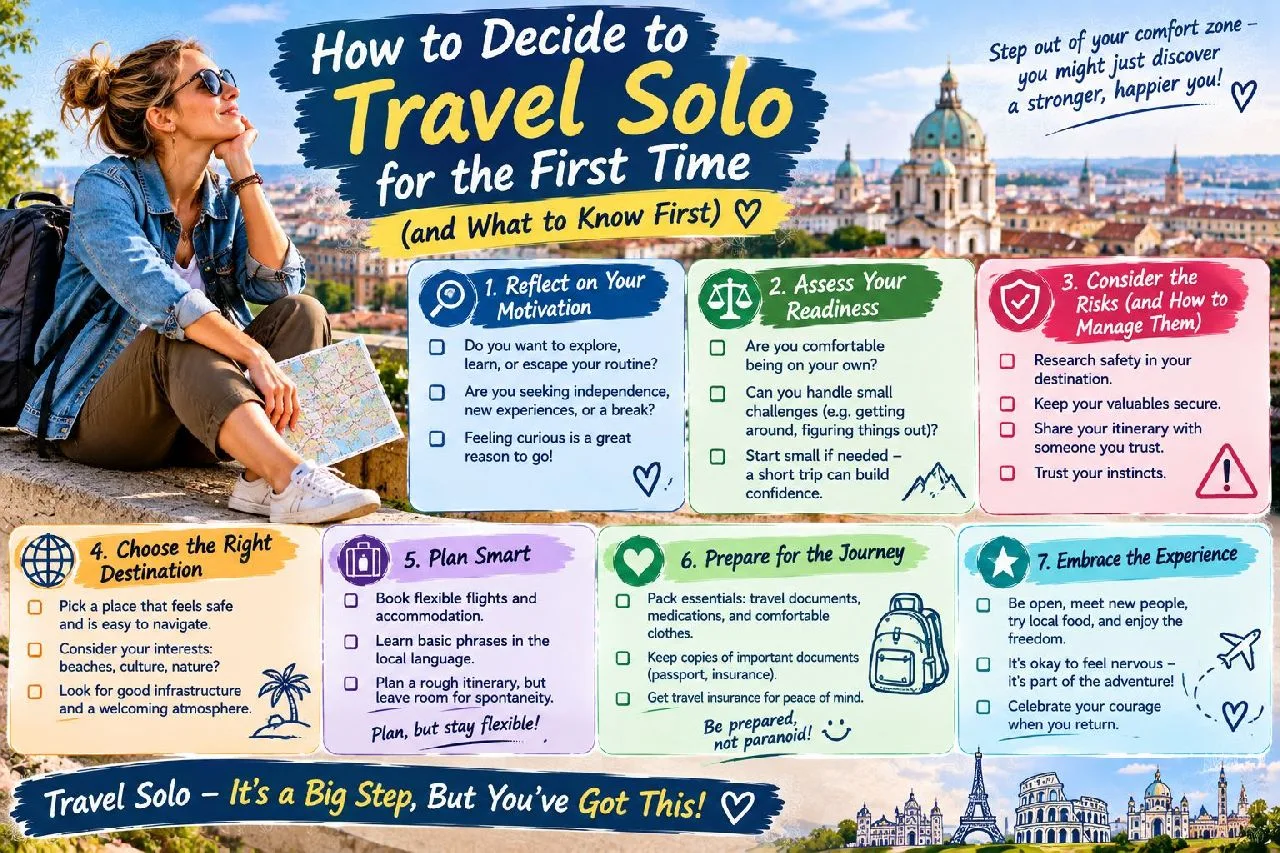
Quick answer: If you are thinking about a first solo trip, start small: choose an easy, safe destination, travel for three to five days, book your first night and your airport transfer in advance, and keep your itinerary flexible. Most first-timers say the hardest part is the decision, not the trip.
Why the decision feels hard
Common worries include loneliness, safety, eating alone and making mistakes with no one to share the burden. These are normal. The useful move is to break each worry into a specific problem you can plan for.
| The worry | The specific problem | What helps |
|---|---|---|
| “I will be lonely” | Long stretches with nobody to talk to | Book one social activity early, stay somewhere with shared spaces, schedule calls home |
| “It might not be safe” | Arrival, getting around at night, theft | Choose an easy destination, pre-book your first night and transfer, share your plans |
| “I will feel awkward eating alone” | Sitting at a table for one | Start with lunch, sit at a counter, bring a book |
| “What if something goes wrong?” | Nobody to share the problem solving | Insurance, backup card, copies of documents, a simple plan B |
| “I will waste money or time” | Making poor choices without a second opinion | Keep the first trip short and the plan flexible |
Once a vague fear becomes a specific problem, it usually has a practical answer. Many first-timers find that the anxiety before the trip is much bigger than anything they actually meet once they are there.
A simple way to decide
- Define the trip: How many days, what budget, and what you want from it (rest, culture, adventure, company).
- Pick an easy first destination: A city with good public transport, English widely spoken, a strong hostel or small-hotel scene and a reputation for safety. Examples include Lisbon, Vienna, Amsterdam, Copenhagen, Tokyo and Singapore.
- Try a low-stakes test: A solo day trip or a weekend in your own country shows how you handle your own company.
- Plan your exit: Decide in advance what you will do if you hate it (for example, book a flexible return or a nearby friend visit).
If you are still unsure, ask yourself a few questions. What exactly am I afraid of? Is it a real risk or a feeling? What would I regret more: going and finding it hard, or never trying? What is the smallest version of this trip that I would be willing to do? The answers often point to a shorter, simpler first trip, which is a perfectly good place to start.
Signs you may be ready (and what to do if you are not sure)
- You keep daydreaming about a trip, and you are not waiting for someone else to say yes.
- You can imagine spending a day on your own, going to a cafe or museum without feeling uneasy.
- You have a rough idea of the budget and the time you can spare.
- You can name your worries and have at least one idea for each.
If you are not sure, you do not have to jump straight to a week in another country. Spend a day in your own city as if you were a tourist, have lunch alone, visit a museum or walk somewhere new. Then try a night or two away. Each small step shows you how you feel and builds confidence for the next one.
Choosing your first destination
The best first destination is one that is easy, not necessarily the one you dream about most. Look for reliable public transport, a walkable centre, plenty of accommodation, good healthcare and a culture that is comfortable with visitors travelling alone. Save the remote, complicated or very demanding trips for later, once you know how you like to travel.
If you are comparing cities, our Solo-Readiness Score explains how we rate cities for solo travellers. For city guides written with first-timers in mind, see our pages on Edinburgh, Paris, Barcelona and Athens.
Shape your first trip
A short first trip works best when you give it a simple structure:
- Arrive in daylight if you can. A first arrival is much easier when you can see where you are going.
- Keep the first day light. Drop your bags, walk around the neighbourhood, find a place to eat and get an early night.
- Give each day one anchor. A booked tour, a museum with a timed ticket or a reservation for lunch gives the day shape without filling it.
- Stay in one place. One base for three to five days avoids the stress of packing and moving.
- Leave one afternoon free. Some of the best moments come from simply wandering.
What to know before you go
- Loneliness comes and goes. Plan social moments: a walking tour, a cooking class, a hostel common room, a language exchange.
- Eating alone gets easier. Bring a book, sit at the bar or counter, or start with lunch rather than dinner.
- You are in charge of the schedule. Do not overpack the days. Leave blank space.
- Safety is mostly preparation. Share your itinerary, keep copies of your documents, use official transport at night and trust your instincts.
- Money: Carry a backup card in a separate place, and tell your bank where you are going.
It also helps to know that the first day or two are often the hardest. You are tired, everything is unfamiliar and you have not yet found your rhythm. Most travellers report that this feeling fades once they have found a favourite cafe, learned the transport and had a good meal. Give yourself time before judging the trip.
Budgeting for a first trip
You do not need to spend a lot on a first solo trip. A short city break with a modest hotel or a private room in a hostel, simple meals and a couple of paid activities is enough to tell you whether you enjoy solo travel. Remember that solo travellers often pay more per person for rooms, so look for single rooms, small guesthouses and hostels with private rooms. Keep a small reserve for the unexpected, such as a taxi after a missed connection or a replacement phone charger, and keep it separate from your main spending money.
Practical checklist
- Passport valid for the required period, plus any visa or authorization.
- Travel insurance that covers medical care and cancellations.
- First night booked, plus transport from the airport.
- Offline maps and a way to get mobile data. See how to stay connected while travelling abroad.
- Copies of documents. See how to protect your travel documents.
- A backup payment card and a small amount of local cash.
- Emergency contacts and your accommodation address saved on your phone and on paper.
- A short plan for the first evening: where you will eat and how you will get there.
Common first-timer mistakes
- Over-planning every hour, or booking nothing at all.
- Choosing a remote destination for a first trip.
- Arriving late at night in an unfamiliar city without a plan.
- Skipping insurance.
- Trying to see everything, instead of leaving space to rest.
- Comparing your trip with other people’s posts and feeling you should be having a more exciting time.
Our guide on 5 mistakes to avoid when traveling alone goes into more detail, and our article on solo travel scams explains what to watch for in busy tourist areas.
FAQ
Is solo travel safe for beginners?
Yes, with sensible destination choices and preparation. Read our solo travel safety guide.
How long should a first solo trip be?
Three to seven days is plenty to learn how you like to travel.
What if I get lonely?
Plan group activities, stay somewhere social, and call home. Loneliness usually passes.
Do I need to speak the local language?
No. In many popular destinations, English is widely spoken in tourist areas. Learn a few basic phrases, such as hello, please and thank you, and use a translation app for anything more complicated.
Should I travel with a friend first?
It is up to you. Some people prefer to build confidence with a trip together, while others find that going alone from the start gives them more freedom. Either way, a short first solo trip is a good low-risk test.
What if I hate it?
Then you will have learned something useful, and you can change plans. Choose flexible bookings where possible, and give yourself a day or two before deciding. Many people find that the first day is the hardest, and they enjoy the rest of the trip much more.
Is a group tour a good way to start?
It can be, especially if you want company or help with logistics. See solo travel vs group tours to compare the options.
Keep planning
- Traveling alone for the first time
- How to plan a solo trip
- Solo travel safety
- Solo travel vs group tours

Hi, I’m Lily, a solo traveller, slow travel advocate and writer based in Wales. I’ve been exploring Europe independently for 9 years, mostly by train, mostly without a rigid itinerary, and almost always alone.
I’ve taken 55+ solo trips through France, Italy, Spain, Portugal, Germany, the Netherlands, the Balkans, the Baltics and Scandinavia. I speak French and Italian, both learned on the road rather than in a classroom, which means I’m better at ordering wine and arguing with train conductors than I am at formal grammar.
My particular passion is the parts of Europe that don’t make the Instagram highlight reels: the underrated cities, the regional trains that no one takes, the local markets, the restaurants where you’re the only foreigner and the menu isn’t in English. I’ve eaten alone in some of the world’s best restaurants and some of its scruffiest tavernas, and I firmly believe solo dining is one of the great underrated pleasures of travel.
I write practical guides for solo travellers who want to actually experience a place, not just tick it off a list.