
Last Updated on
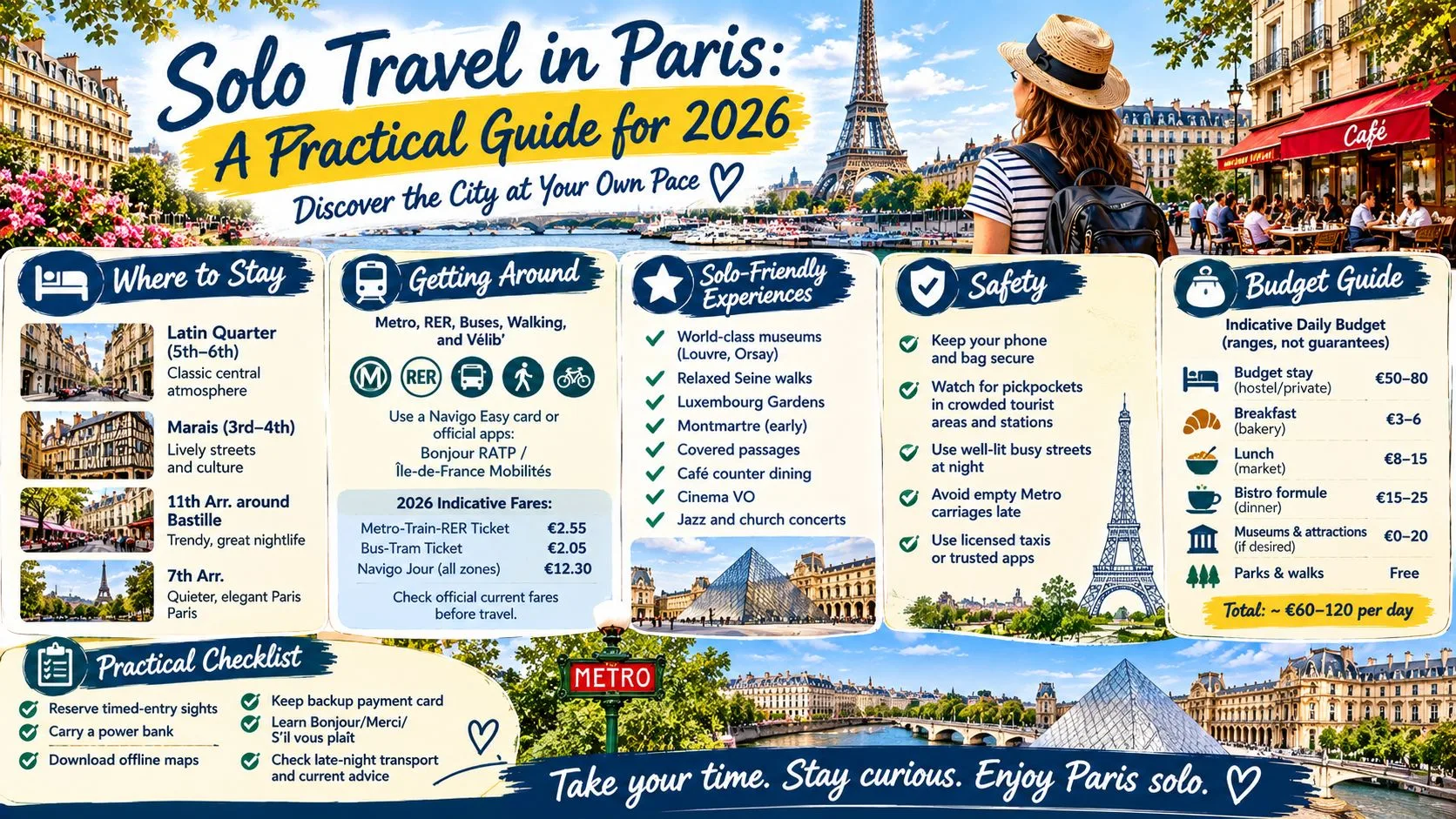
Quick answer: Paris is a classic solo city: cafes made for people-watching, world-class museums, and neighborhoods you can wander for hours. It can feel lonely or intimidating if you do not plan, so mix big sights with small rituals. Stay in the Marais, Latin Quarter or Saint-Germain, pre-book the Louvre and Eiffel Tower, and say “Bonjour” every time you enter a shop.
Is Paris good for solo travel?
Yes. The city is walkable, the metro is dense, and sitting alone in a cafe is a normal and respected activity. It is expensive and crowded, and tourist-area scams are common. Paris has a reputation as a city for couples, but in practice you will see people reading alone on cafe terraces, eating lunch with a book and wandering museums by themselves at every hour of the day. Nobody stares. Solo travel actually suits the city’s rhythm: you can linger in a gallery as long as you like, change plans when it rains, and follow the smell of fresh bread down a side street without negotiating with anyone. The trade-off is that Paris rewards a little preparation, especially around booking tickets, opening days and basic manners.
Where to stay
| Area | Best for | Keep in mind |
|---|---|---|
| Le Marais (3rd/4th) | Central, lively, cafes | Busy, pricey |
| Latin Quarter / Saint-Germain (5th/6th) | Classic Paris, bookshops, safe feel | Touristy, costly |
| Montmartre (18th) | Village feel, views | Steep, crowded near Sacré-Cœur; take care at night |
| Canal Saint-Martin (10th) | Hip, cafes, nightlife | Rowdier |
Whichever area you choose, stay within a short walk of a metro station and read recent reviews from solo guests, especially about the street at night. A small hotel with a front desk, or a well-reviewed hostel with a private room, gives you someone to ask for advice and a reassuring welcome when you come back late. Rooms in Paris are compact, so central location matters more than size when you plan to spend your days outside.
Getting around
- Metro and RER: Extensive. Contactless and app-based ticketing options exist; check what is current.
- Walking: The best way to see the city.
- Airports: RER B and buses serve Charles de Gaulle; options vary for Orly. Check current links.
- Bikes: Paris has a large network of bike lanes and bike share.
Most visitors are surprised by how much they can see on foot. The walk from the Marais to the Notre-Dame area takes roughly 15 to 20 minutes, and you can stroll along the Seine from the Louvre to the Eiffel Tower in about an hour, with plenty of reasons to stop. Save the metro for longer hops and rainy afternoons. Late at night the metro runs less often and eventually stops for a few hours, so work out your route home before you head out to dinner. Night buses, taxis and ride-hailing apps fill the gap.
What to do
- Louvre and Musée d’Orsay. Book timed tickets. The Centre Pompidou building has been announced as closed for a multi-year renovation, so check current plans before you count on it.
- Eiffel Tower: Book ahead for the summit, or enjoy it from the Trocadéro.
- Notre-Dame area and Sainte-Chapelle.
- Seine walks, Luxembourg Gardens and covered passages.
- Montmartre at sunrise.
- Day trips: Versailles, Giverny and Fontainebleau.
Making the big sights easier alone
The famous attractions are where solo travelers lose the most time, mainly to queues. Book timed tickets online, choose the first slot of the morning or a late-afternoon slot, and check the weekly closing day before you plan, because major museums close on different days (the Louvre and the Musée d’Orsay do not share the same day off). Several large museums also stay open late one evening a week, which is a calm time to visit. Notre-Dame reopened after its restoration, so check the current entry and reservation rules before you go.
Quiet ideas that suit one person
- Browse the covered passages, such as Galerie Vivienne and Passage des Panoramas, then stop for coffee.
- Spend an hour at Shakespeare and Company or in the second-hand bookstalls along the Seine.
- Walk through Parc des Buttes-Chaumont or the Rodin Museum garden when the main sights feel too crowded.
- Watch the sun go down from the Pont Neuf or the tip of the Île de la Cité, then see the Eiffel Tower sparkle briefly on the hour after dark.
- Catch a film in a small cinema. Many show international films in the original language with French subtitles.
- Book a walking photoshoot designed for solo travelers if you want photos of yourself without handing your phone to strangers.
A simple 3-day solo itinerary
Day 1: Marais and the islands. Start with coffee and a pastry near Place des Vosges, then explore the Marais streets and courtyards. Walk to the Île de la Cité for the Notre-Dame area and Sainte-Chapelle, then cross to the Île Saint-Louis for a slow afternoon. End the day with a riverside walk and an early dinner. Day 2: Louvre and the right bank. Visit the Louvre at opening time with a timed ticket, then walk through the Tuileries Garden to the Palais-Royal and the nearby covered passages for lunch. In the evening, head to the Trocadéro for a view of the Eiffel Tower, or book a Seine cruise if you want to see the city lit up without walking. Day 3: Montmartre and the Left Bank. Go up to Montmartre at sunrise, before the crowds arrive at Sacré-Cœur. Spend the afternoon in the Latin Quarter and the Luxembourg Gardens, and finish with an evening browse at a bookshop or a film. If you have four or five days, add the Musée d’Orsay, a market morning, and a day trip to Versailles, Giverny (a seasonal garden, so check opening dates) or Fontainebleau. Leave one afternoon with no plans at all. Some of the best solo moments in Paris happen when you simply sit down somewhere.
Eating alone
A cafe terrace, a bakery, a bistro lunch menu (formule), and a market picnic are all great solo options. Sit at the bar or a small table. The bill is not automatically brought, so ask for “l’addition”. Tipping is not required, as service is included. A few habits make eating alone easier:
- Make lunch your main meal. A formule or plat du jour is usually better value than dinner.
- Say “Une table pour une personne, s’il vous plaît.” Staff are used to it, and a counter seat or a small table by the window is easy to find outside peak hours.
- Coffee is usually cheaper standing at the bar than sitting on a terrace, though the terrace is the better place to people-watch.
- Many kitchens close between lunch and dinner service, and Parisians tend to dine from around 7:30 pm. If you are hungry earlier, a bakery or cafe is the answer.
- Wine bars and small counter-style restaurants are especially welcoming to solo diners. Markets such as Marché des Enfants Rouges in the Marais are good for a relaxed lunch.
Feeling lonely
Paris can feel isolating. Join a walking or food tour, take a class (cooking, perfume, art), go to a language exchange, or stay in a social hostel. Evening events and museum late openings are a good way to be among people without needing to talk. It helps to give each day one anchor, such as a booked tour, a class or a reservation, and leave the rest open. That small structure means you always have somewhere to be and someone to talk to, while still keeping the freedom that makes solo travel worth doing. If an evening feels flat, a long call home or an early night is a perfectly good plan. For more ideas, read our guide on how to meet people when you travel solo.
Safety
Pickpocketing is common at the Eiffel Tower, Louvre, Sacré-Cœur, in the metro and at train stations. Watch out for petition scams, “gold ring” tricks and friendship-bracelet sellers. Avoid isolated areas late at night. The emergency number is 112. See our solo travel safety guide. Some practical habits help a lot:
- Carry a zipped cross-body bag in front of you, and keep your phone out of back pockets and off cafe tables.
- On the metro, avoid holding your phone near the doors, because grab-and-run thefts happen as the doors close.
- If someone approaches you with a clipboard, a ring or a bracelet, a firm “non, merci” and a steady walk is enough.
- Keep a copy of your passport and insurance details separate from the originals.
- Share your general plans with someone at home, especially for late evenings.
Most solo travelers, including women traveling alone, report that Paris feels comfortable in busy central areas during the day and evening. Stay aware, trust your instincts, and use a taxi or ride-hailing app when a late-night route looks quiet. For a wider comparison, see our list of European cities that work well for solo female travellers, and consider a policy from our solo travel insurance comparison.
Keeping costs down
Paris is expensive for one person because hotel rooms are priced per room, not per traveler. You can soften the cost by eating your main meal at lunch, picnicking with market food, walking instead of paying for transport, and spending time in free parks and neighborhoods. Check whether a museum pass or a youth or resident discount applies to you before buying individual tickets. Our solo travel in Paris on a budget guide goes deeper on what to skip and what to savour.
Best time
April to June and September to October. July and August are hot, and some local businesses close. Winter is grey but quieter, with Christmas lights. Shoulder seasons give you the best balance of pleasant weather, shorter queues and lower prices.
What to pack
Comfortable walking shoes are the single most important item, since you will easily cover many kilometers a day on cobblestones. Add a zipped cross-body bag, a portable battery, a European plug adapter if you need one, and a layer for evenings, as the weather can change quickly. A small notebook is a nice extra for solo trips.
Paris solo FAQ
How many days do you need?
Three to five days. Three is enough for the main sights and neighborhoods, and five lets you slow down or add a day trip.
Do I need French?
No, but greeting people in French is expected and appreciated. Start every interaction with “Bonjour” and finish with “Merci, bonne journée”, and you will notice the difference immediately.
Is Paris expensive?
Yes, especially hotels. Museums, bakeries and picnics keep costs down.
Is Paris safe for solo women?
Busy central areas are generally comfortable, and many women travel Paris alone. Pickpocketing and street scams are the main issues, so use the habits above and plan late-night transport in advance.
Is it awkward to eat alone in Paris?
Not at all. Cafes, bistros and wine bars are used to solo diners, and a book or a journal makes it feel even more natural.
Keep planning

Hi, I’m Lily, a solo traveller, slow travel advocate and writer based in Wales. I’ve been exploring Europe independently for 9 years, mostly by train, mostly without a rigid itinerary, and almost always alone.
I’ve taken 55+ solo trips through France, Italy, Spain, Portugal, Germany, the Netherlands, the Balkans, the Baltics and Scandinavia. I speak French and Italian, both learned on the road rather than in a classroom, which means I’m better at ordering wine and arguing with train conductors than I am at formal grammar.
My particular passion is the parts of Europe that don’t make the Instagram highlight reels: the underrated cities, the regional trains that no one takes, the local markets, the restaurants where you’re the only foreigner and the menu isn’t in English. I’ve eaten alone in some of the world’s best restaurants and some of its scruffiest tavernas, and I firmly believe solo dining is one of the great underrated pleasures of travel.
I write practical guides for solo travellers who want to actually experience a place, not just tick it off a list.