
Last Updated on
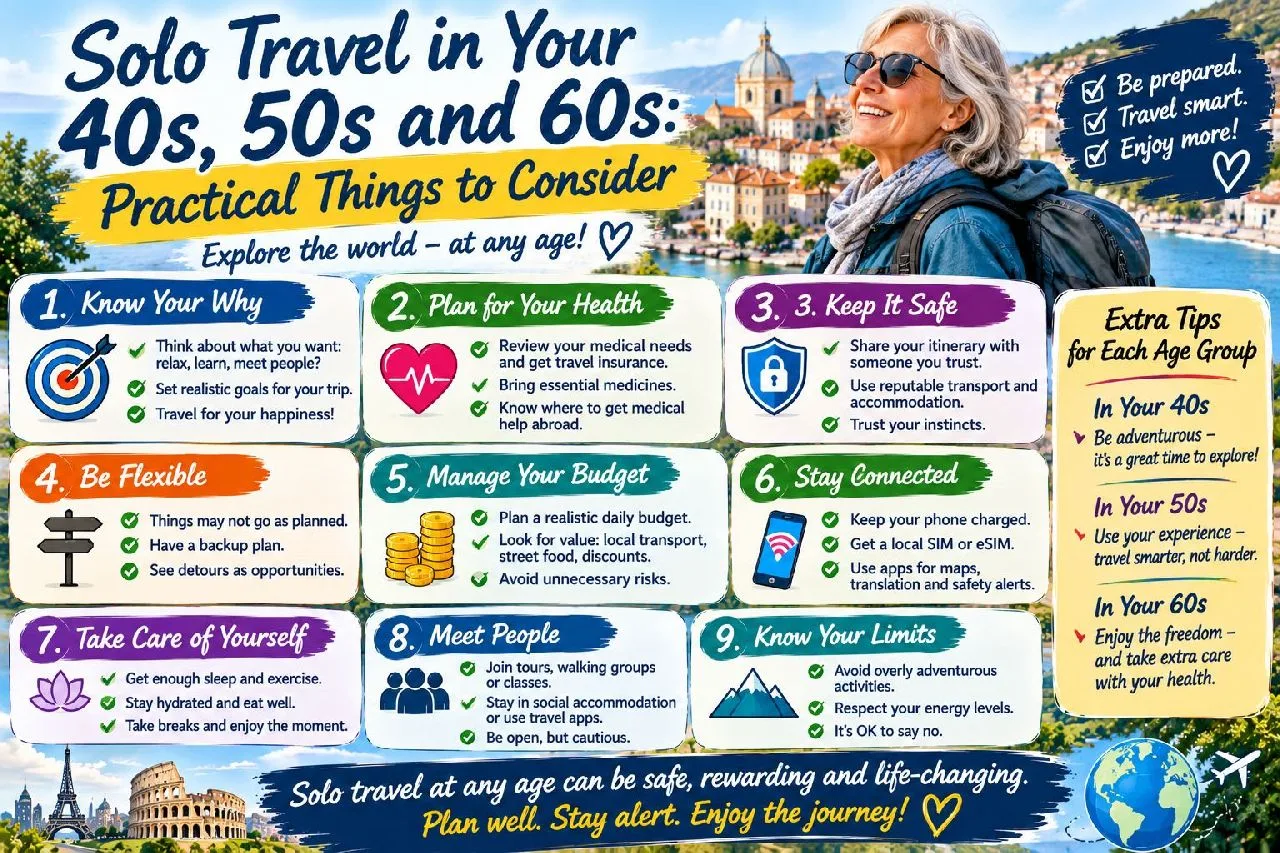
Quick answer: There is no single way to travel solo in your 40s, 50s or 60s. Fitness, budget, confidence and interests vary far more between individuals than between decades. That said, some practical points come up often at this stage of life: balancing work or family commitments, planning for health and insurance, choosing comfortable accommodation, and building in the right amount of pace and company. This guide covers those considerations without assuming what any age group wants.Common Themes at Different Stages
These are general patterns that many people report, not rules. Plenty of travellers in their 60s hike mountains, and plenty in their 40s prefer slow trips.| Stage | Common considerations |
|---|---|
| 40s | Fitting trips around work and family, using limited leave well, mixing active and relaxing days |
| 50s | More flexibility with time or budget for some, a wish for comfort and meaningful experiences, planning around health needs |
| 60s and beyond | Often more time, a preference for comfortable pacing for some, closer attention to health, insurance and mobility |
Plan Your Pace and Style
- Choose fewer places and stay longer. It reduces travel fatigue at any age.
- Mix active days and rest days. Plan the energetic activities for when you feel best.
- Pick activities that match your fitness. Check the difficulty, distance and terrain for walks, treks and tours.
- Consider guided or small-group activities for the parts that are logistically hard. See solo travel vs group tours.
- Use long weekends and holidays well if time is limited. Choose destinations with good flight connections.
Choosing a Destination and Trip Type
If you are not sure where to start, look for places that make the practical side easy: good public transport, a walkable centre, reliable healthcare, plenty of accommodation choices and a culture that is comfortable with people travelling alone. Many European cities fit this description, and our guides to Edinburgh, Paris, Barcelona and Athens are good places to begin.The type of trip matters as much as the place. Some options that suit solo travellers of any age:- City breaks: Compact, flexible and easy to cut short or extend.
- Slow travel: One base for a week or two, with day trips. Good for recovering energy and meeting locals.
- Rail journeys: Comfortable, scenic and simple to plan, with luggage handled for you.
- Walking holidays: Self-guided or small-group routes, with a choice of difficulty and luggage transfers on many trails.
- Small-group tours: Useful for harder logistics, remote areas or when you want company on arrival.
- Cruises and organised holidays: Convenient, though solo cabins can carry a single supplement, so compare prices carefully.
Combining Work and Travel
- Set clear boundaries between work hours and exploring.
- Choose accommodation with reliable Wi-Fi and a decent workspace.
- Look for time zones that fit your working hours.
- Consider co-working spaces, which also help you meet people.
Health, Insurance and Safety
- Check-up: If you have health concerns, talk to your doctor before booking a long or demanding trip.
- Medication: Carry enough in original packaging, with a copy of prescriptions. Check that it is legal at your destination.
- Insurance: Look for cover that includes medical care, evacuation and any pre-existing conditions you have declared. Policies often have age limits or higher premiums with age, so compare options and read the exclusions.
- Know the local healthcare options and how to reach emergency services.
- Vaccinations: Check government travel health advice early.
- Stay hydrated, protect against the sun and rest when you need to.
- General safety: Share your itinerary, use trusted transport and keep emergency contacts handy. See our solo travel safety guide.
Accommodation and Comfort
| Option | Good for |
|---|---|
| Small hotel or B&B | Comfort, privacy and helpful hosts |
| Guesthouse | Local feel and personal tips |
| Hostel private room | Budget travellers who still want social spaces. Hostels welcome all ages |
| Apartment | Longer stays, kitchen access and more space |
- Choose a central location near transport to reduce walking and transfers.
- Check for lifts if you have mobility concerns, because many older European buildings have steep stairs.
- Read recent reviews for noise, bed comfort and cleanliness.
Budgeting
Your budget depends on your income, savings and priorities. Some travellers choose to spend more on comfort, others prefer to keep costs low and travel for longer. Useful ways to stretch money include:- Off-season or shoulder-season travel
- Booking flights and accommodation early
- Using loyalty and reward programmes, and senior or concession discounts where available
- Eating where locals eat, and at markets
- Free walking tours, museum free days and parks
Money, Documents and Technology Basics
- Carry two ways to pay, such as a debit card and a credit card, and keep them in separate places.
- Tell your bank where you are going and check any foreign transaction fees.
- Check that your passport is valid for long enough. Many countries require several months of validity.
- Keep digital and paper copies of your passport, insurance and bookings, stored separately from the originals.
- Download offline maps, translation packs and your booking confirmations before you leave.
- Make sure you can still receive security codes for your accounts while abroad, or set up a backup method.
- Carry a power bank and a plug adapter.
Meeting People
- Join small-group tours, cooking classes or walking tours.
- Stay somewhere with shared spaces, such as a guesthouse with communal breakfast.
- Try meetups, language exchanges and volunteering. Research organisers carefully.
- Keep regular contact with friends and family at home.
- Allow time alone too. Many people enjoy both.
Common Challenges
Loneliness
It can happen at any age. Plan some social activities, schedule calls home and give yourself permission to rest.Planning and flexibility
Book key items in advance, such as the first nights, popular attractions and transport, but leave some days open. Choose flexible cancellation options where possible.Language and culture
Learn key phrases, use translation apps and research local customs. Observing locals and being patient goes a long way.Technology
Download offline maps and translation packs, and keep a paper copy of important details. A power bank is useful.Feeling self-conscious
Eating alone, asking for a table for one or sightseeing without company can feel awkward at first, particularly if you are used to travelling with a partner, family or friends. It usually gets easier after the first day. A book, a journal or a seat at the bar helps, and most restaurants and cafes see solo guests every day.Travelling after a life change
A first solo trip after a separation, bereavement, retirement or a change in family circumstances can be freeing and emotional at the same time. Allow room for both. Choose a destination that feels manageable, keep your plans simple, and stay in touch with someone you trust. If difficult feelings persist, talking to a friend, family member or professional is a good idea.Family and work commitments
If you are balancing caring responsibilities or a demanding job, keep the first trip short and close enough to return quickly if you need to. Share your itinerary and contact details, agree how often you will check in, and choose accommodation with reliable communication.Benefits of Solo Travel Later in Life
- Self-knowledge: You often know what you enjoy and what you do not, which makes planning easier.
- Freedom: No need to compromise on pace, destinations or activities.
- Confidence: Managing a trip alone can be rewarding.
- New friendships: Travel can lead to connections across ages and cultures.
FAQ
Is solo travel different after 50?
It can be, mostly in practical ways such as health planning, insurance and comfort preferences. Many people also feel more confident. Individual differences matter most.Which safety concerns matter most?
The same as for any traveller, plus health planning: medication, insurance and knowing local healthcare options.Is it harder to meet people?
Not necessarily. Tours, classes and shared accommodation attract people of all ages, and shared interests matter more than age.What should I pack?
Pack light, with supportive shoes, any medication and a small first aid kit, a power bank and copies of documents. See first solo trip abroad: preparation checklist.Are there age limits on travel insurance?
Some policies have age limits or charge more with age, while others are designed for older travellers. Compare several options and check the medical limits and exclusions.Should I book everything in advance?
Book your first nights, transport for long journeys and popular attractions, then leave some flexibility. That gives you security on arrival and room to change plans.Is a group tour a better choice than travelling independently?
Neither is better. Tours can reduce planning and give you company, and independent travel gives you freedom. Many people combine both. See solo travel vs group tours.Keep Planning
- Traveling alone for the first time
- Solo travel safety
- The ultimate guide to solo travel
- What’s the best age to start solo travelling?
- Solo travel insurance comparison

Hi, I’m Lily, a solo traveller, slow travel advocate and writer based in Wales. I’ve been exploring Europe independently for 9 years, mostly by train, mostly without a rigid itinerary, and almost always alone.
I’ve taken 55+ solo trips through France, Italy, Spain, Portugal, Germany, the Netherlands, the Balkans, the Baltics and Scandinavia. I speak French and Italian, both learned on the road rather than in a classroom, which means I’m better at ordering wine and arguing with train conductors than I am at formal grammar.
My particular passion is the parts of Europe that don’t make the Instagram highlight reels: the underrated cities, the regional trains that no one takes, the local markets, the restaurants where you’re the only foreigner and the menu isn’t in English. I’ve eaten alone in some of the world’s best restaurants and some of its scruffiest tavernas, and I firmly believe solo dining is one of the great underrated pleasures of travel.
I write practical guides for solo travellers who want to actually experience a place, not just tick it off a list.