


Top 8 Best Day Trips from Bogotá in 2025
Discover the best day trips from Bogotá, including colonial towns and natural wonders. Plan your per…

The Americas, with their extraordinary diversity and richness, offer an unparalleled travel experience. From the icy fjords of Alaska to the tropical beaches of the Caribbean, and from ancient ruins in Central America to cosmopolitan cities in North and South America, this region captivates travelers with its vast array of attractions.
The Americas offer a solo travel range that no other continent matches, from the hyper-organized ease of Canada and the United States to the extraordinary cultural and natural richness of South America, with its food, music, tango, coffee, and landscapes that exist nowhere else on earth. The challenge is scale: the Americas are large in a way that Europe is not, and the distances between worthwhile destinations require more planning than a Europass and an open schedule.
The practical division that matters most for solo trip planning: North America (US and Canada) operates on a familiar infrastructure model: English language, reliable transport, predictable safety profile, high cost. South America (Argentina, Colombia and beyond) operates on a different model: significant cultural richness, lower cost, higher safety awareness required, and Spanish essential for anything beyond the surface. Both are excellent. They require different preparation.
The United States and Canada are among the most logistically straightforward solo travel destinations in the world for English-speaking visitors. The infrastructure, domestic flights, Amtrak and Via Rail trains, extensive bus networks, Uber/Lyft everywhere, is reliable. English removes the language barrier entirely. The cities are large, diverse and have mature solo travel ecosystems: hostels, solo-friendly restaurants, active meetup and social cultures.
The cost is the primary challenge: the US and Canada are expensive by global standards. Accommodation, food and transport all require more budget per day than Europe, let alone South America. Mitigation: both countries reward cooking your own food, using public transport rather than taxis, and choosing accommodation away from tourist-centre pricing.
Las Vegas, New York, Los Angeles, Toronto, these are the most-visited cities in the region and all are covered in depth in the destination guides linked below. Each rewards solo travel differently: New York for the density of experience per day, Las Vegas for the unique cultural environment, LA for the food neighbourhood diversity, Toronto for the welcome it extends to international visitors.
Argentina and Colombia are the two South American destinations covered in depth in this network, and both require a different preparation mindset from North American or European destinations. Safety awareness, Spanish language basics, and some advance knowledge of local conditions are prerequisites for getting the most from a South American solo trip.
The reward for that preparation: food culture, tango, coffee, landscapes and warmth that are specific to this part of the world and genuinely unlike anything in Europe or North America. Buenos Aires in particular operates on a social schedule and energy that most visitors have never encountered, dinner at 10pm, clubs at 2am, and a quality of outdoor café life that rivals Paris without the price. Colombia’s diversity: coast, mountains, coffee region, major cities, is extraordinary for a relatively compact country.
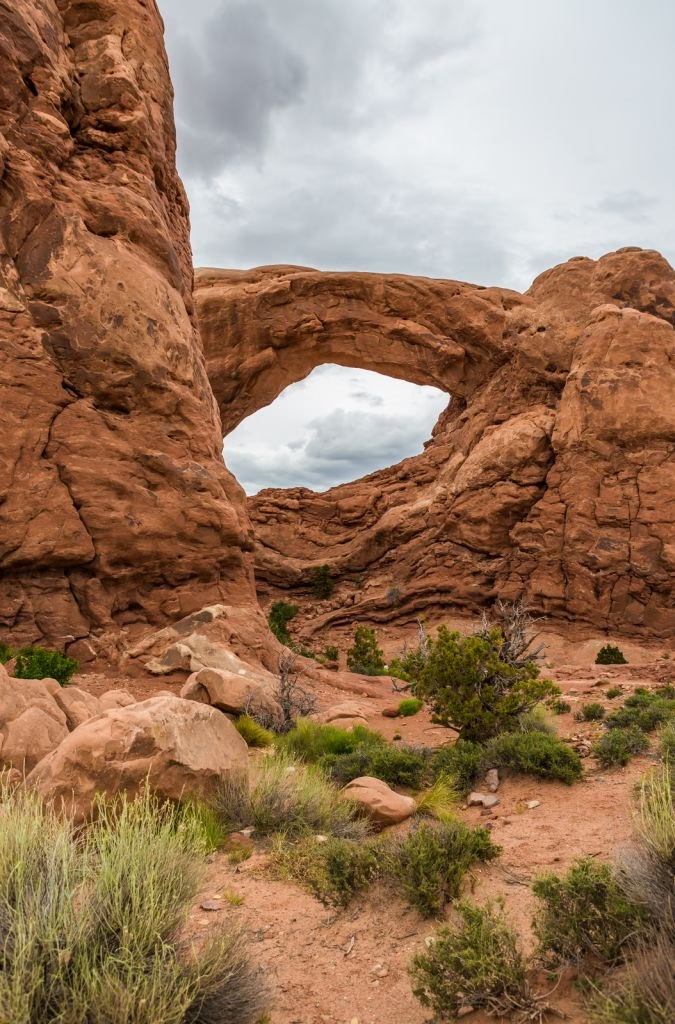
North America: May–June and September–October avoid the worst of summer crowds and heat in the US. Canada is excellent June–September. December for New York Christmas atmosphere.
South America: Argentina’s seasons are reversed from the Northern Hemisphere, December to February is summer and peak tourist season in Buenos Aires. March to May and September to November are excellent shoulder season periods. Colombia is broadly year-round but avoids the April–May and September–November heavier rainy periods for the mountains.
Written by Jennifer Ann Porter, solo travel writer at gotravelyourself.com. Jenny covers North American and South American destinations.