
Last Updated on
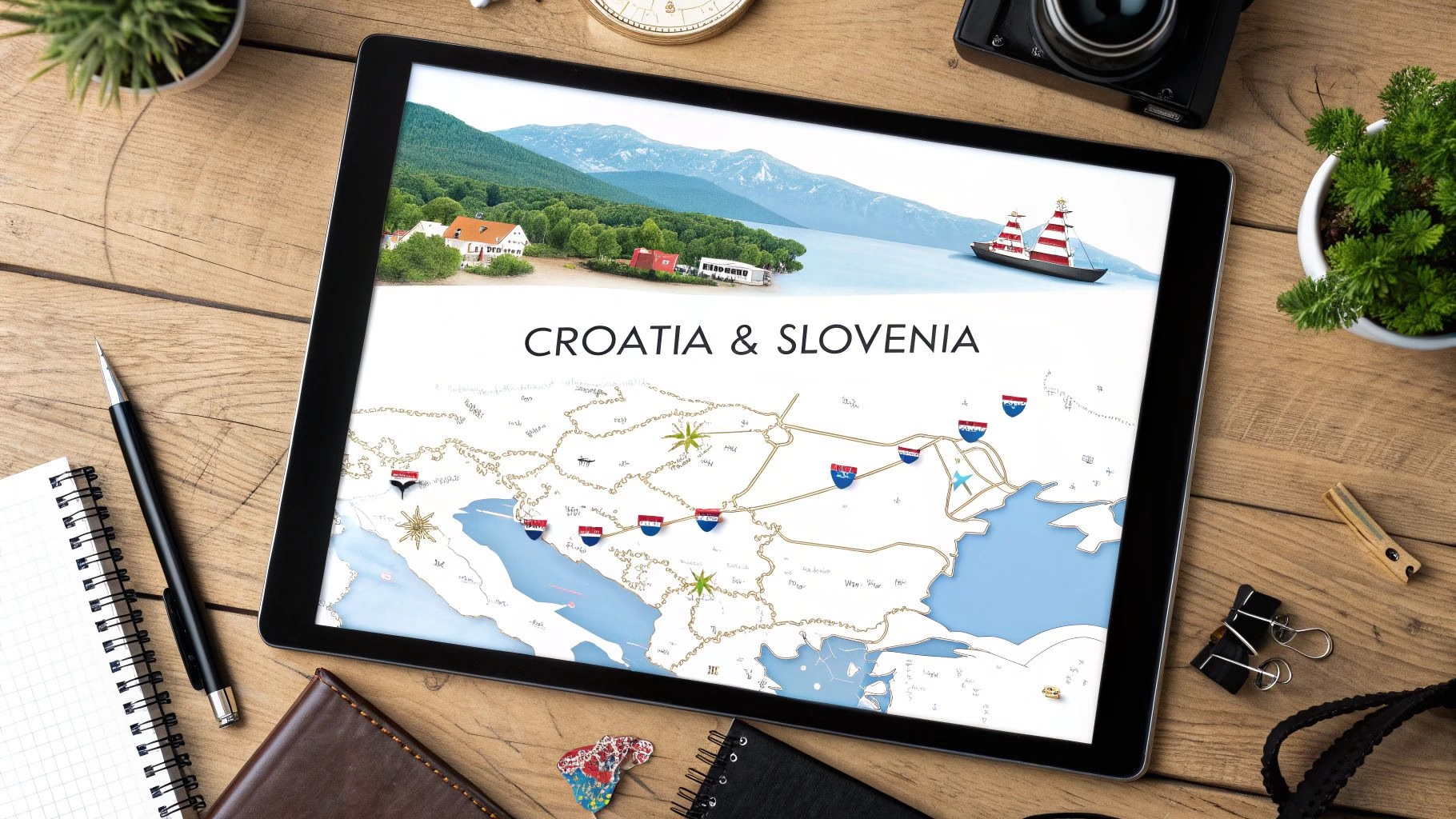
Croatia and Slovenia sit side by side and are easy to combine: Ljubljana to Zagreb is about 141 km, and since 11 June 2026 there have been no routine checks at the land border. This page gives you the maps, the distances, how to cross the border, how to get between cities by bus, train and car, and what the roads cost. Slovenia is compact, at about 20,000 square kilometers, while Croatia stretches along the Adriatic and covers about 56,600.
Last checked October 2026 against official government notices and current transport and toll listings. Timetables, tolls and entry rules change, so confirm the details before you travel.
Maps of Slovenia and Croatia
Slovenia
Croatia
Crossing the border
Croatia joined the Schengen Area and adopted the euro on 1 January 2023, so you use euros in both countries and need no currency exchange between them. Slovenia reintroduced temporary checks on its land border with Croatia in October 2023. On 11 June 2026 its government ended those controls and decided not to extend them (Government of Slovenia). Police now rely on random, risk-based checks rather than routine stops at crossing points (EUAA), so expect to drive or ride through without stopping, but carry your passport or ID card anyway.
- If you arrive from outside Europe: you register at the first Schengen external border, where the EU’s Entry/Exit System collects a facial image and fingerprints from non-EU visitors. The 90 days in any 180 rule applies across the whole Schengen Area.
- ETIAS: the €20 travel authorization for visa-exempt visitors is scheduled to start in the last quarter of 2026. Check the official EU travel site for its current status.
- Rental cars: ask whether your rental company allows cross-border travel, and whether it charges a fee, before you drive from one country to the other.
Distances and travel times between key cities
| Route | Distance | By car | By bus or train |
|---|---|---|---|
| Zagreb to Ljubljana | About 141 km | About 1.5 to 2 hours | FlixBus runs roughly hourly, in about 2 to 3 hours for around €13 to €18. Direct trains run about 2 to 4 times a day and take roughly 2h 10m to 2h 40m. |
| Ljubljana to Lake Bled | About 55 km | About 1 hour | Check current bus and train timetables |
| Zagreb to Split | About 400 km | About 4 to 5 hours | Buses are the main option |
| Ljubljana to Split | Not applicable | Long day by car | A direct FlixBus takes roughly 9 to 10 hours, with no direct train |
| Split to Dubrovnik | About 230 km | About 3 to 4 hours | Buses and some ferries |
| Rijeka to Pula (Istria) | About 100 km | About 1.5 to 2 hours | Buses run regularly |
Bus and train details come from Rome2Rio and EveryRail, reviewed in July 2026. Driving times are approximate and depend on traffic and season. For the train network more broadly, see our train travel tips for solo travelers in Europe and our guide to the best Europe train pass.
Driving: tolls and vignettes
- Slovenia uses an e-vignette instead of toll booths. A 7-day vignette for a standard car costs €16 and a monthly one €32. Buy it from the official operator, DARS, before you enter the motorway. The Karawanken Tunnel on the Austrian border has a separate toll (fuel-prices.eu).
- Croatia charges tolls by distance at barrier plazas, including on the A1 motorway to the coast. Zagreb to Split on the A1 costs about €24 in 2026, and the full A1 from Zagreb to its southern end at Karamatići about €30.60 (TollGuru).
- The Pelješac Bridge is toll-free and lets you drive to Dubrovnik without passing through Bosnia and Herzegovina at Neum.
Old-town parking in places such as Dubrovnik is limited and expensive, so base yourself outside the walls and walk.
A classic route: Alpine to Adriatic
For about ten days, travel south in one direction so that you never double back: Ljubljana (2 nights), Lake Bled and the Julian Alps (2), Zagreb (1 or 2), Plitvice Lakes (1), Split (2 or 3), and Dubrovnik (2). Popular sights such as Plitvice and the Dubrovnik walls sell out in summer, so book ahead in peak season.
Regions at a glance
| Region | Country | Highlights | Best for | Best season |
|---|---|---|---|---|
| Istria | Croatia | Hilltop towns such as Motovun and Rovinj, coastal drives | Art and history | Spring and fall |
| Zagreb | Croatia | Austro-Hungarian architecture, museums | City exploring | Spring and fall |
| Dalmatia | Croatia | Diocletian’s Palace in Split, Dubrovnik’s city walls | History and beaches | Summer |
| Ljubljana | Slovenia | Old town, castle, the Ljubljanica River | City breaks | Spring and summer |
| Lake Bled | Slovenia | Island church, castle, hiking trails | Nature | Spring and summer |
| Julian Alps | Slovenia | Hiking, mountain huts, views | Outdoor adventure | Summer |
| Vipava Valley | Slovenia | Wine tasting, vineyards, villages | Food and wine | Spring and fall |
Tips for solo travelers
- Ljubljana and Zagreb make easy bases: both are compact, and buses connect them frequently, so you can change plans without rebooking.
- Buses beat trains for flexibility on this corridor, since trains between the capitals run only a few times a day.
- Download offline maps before you head into the Julian Alps or onto the islands, where signal is patchy.
- For general safety advice, see our solo travel safety guide, and for staying connected abroad, our guide to the best eSIM for international travel.
Frequently asked questions
Do I need a passport to cross from Croatia to Slovenia?
There are no routine border checks since Slovenia ended its controls on 11 June 2026, but random checks are possible, so carry your passport or national ID card.
What currency do Croatia and Slovenia use?
Both use the euro. Croatia adopted it on 1 January 2023.
Can I get from Zagreb to Ljubljana without a car?
Yes. FlixBus runs roughly hourly, and direct trains run about two to four times a day.
Do I need a vignette to drive in Slovenia?
Yes, for motorways. It is an e-vignette bought online, costing €16 for 7 days for a standard car.
Tours and activities for your trip
We may earn a commission if you book through the tours widgets below. This never changes what we write. See our affiliate disclosure.

Hi, I’m Jenny, a solo travel writer based in the UK with nearly a decade of independent travel under my belt. I took my first solo trip at 24, a slightly terrifying two weeks in Vietnam, and I’ve been hooked ever since.
Over the past 9 years I’ve completed 60+ solo trips across Europe, Southeast Asia, Central America and Japan, from weekend city breaks in Prague to three-week overland journeys through the Balkans. I speak conversational French and basic Spanish, which has opened more doors (and more dinner tables) than any guidebook ever could.
My writing focuses on the practical stuff solo female travellers actually need: safety, navigation, budget-stretching, and finding genuine connection on the road. I don’t do fluff. If I haven’t personally figured out whether a city is safe to walk home alone at midnight, I won’t pretend I have.
When I’m not writing I’m usually planning the next one, or eating something I can’t pronounce.